Hachiko died at Shibuya Station, still waiting for his owner to return until his last breath. What remains of Hachiko is in the National Science Museum of Japan in Tokyo.
Hachiko
Hachiko and Professor Ueno
Hachiko's story took place in the period between the world wars. This is, of course, an Akita dog, born in 1923 in Akita Prefecture and brought to Tokyo in 1924 by its owner, Professor Hidesaburo Ueno, who worked in the Department of Agriculture at the University of Tokyo. They lived in the Shibuya neighborhood of Tokyo, and every morning Hachiko would accompany his husband to the train station when he went to work. Every evening, at exactly the time when Professor Ueno was supposed to return, Hachiko would arrive at the train station to greet him and they would return home together. For a year and four months, things went like this.
One day Professor Ueno did not return home. It turned out that he died of a sudden cerebral hemorrhage while he was sitting at the university. Hachiko was found another home but he managed to escape from there time after time, and returned to his owner's house. After a while, when Hachiko apparently realized that his owner no longer lived there, he would go to the train station in Shibuya every day and wait for him there.

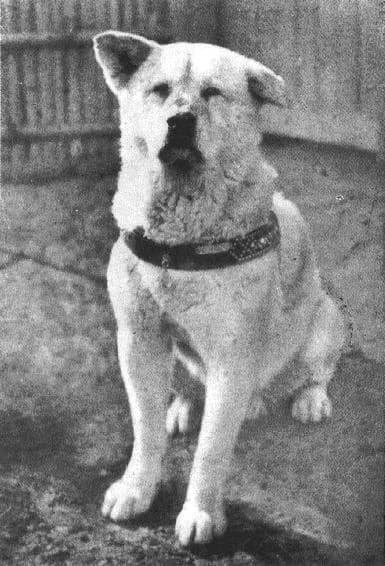
A real photo of Hachiko

Hachiko and Professor Ueno

Saying goodbye to Hachiko

Hachiko's grave
Akita's personality
Months and years passed, the passengers at Shibuya station noticed Hachiko and brought him food and drink. Stories about Hacheko faithfully waiting for his owner began to be published and one of Professor Ueno's students began writing articles about the dog. In 1932, one of the articles was published in the most popular newspaper in Japan, making Hachiko a very famous dog.
In 1934, a bronze statue of the dog was erected at the Shibuya station. The statue stands in its place to this day and is a well-known landmark, the individual as a meeting place. A year later, in 1935, Hachiko died at Shibuya Station, still waiting for his owner to return until his last breath. What remains of Hachiko is in the National Science Museum of Japan in Tokyo.
It is not clear exactly how Hachiko and Professor Ueno spent the year and four months they were together, but it is clear that a close and courageous bond was formed between them that caused the dog to spend the rest of his life - nine years in total - waiting for his owner's return. The loyalty, love and admiration shown by Hachiko is most touching.
In 1937, two years after Hachiko's death, Helen Keller received an Akita dog when she visited Japan. It was the first Akita brought to the United States. Unfortunately, the dog named Kamikaze-go gave up shortly after, but the Ministry of Foreign Affairs sent here another Keller Akita, Kamikaze-go's brother, named Kanzen-go. Then the Second World War broke out and at the end of the war many American soldiers took Akita dogs back to their country and the dog became well known in the United States.
Hachiko's touching story was depicted in a movie about his life with Professor Ueno produced in 1987. This is a Japanese movie called "Hachiko Monogatari". In August 2009, the American version of the film, "Hachiko, the story of a dog", was released. Several children's books have been written about Hachiko. There is no doubt that this is a great example of love and loyalty.
Want to hear more details?
We will be happy to give you personal attention
Or call us now
0549050090
Or
0542337447
before making a decision
If you are debating whether an Akita Inu is suitable for your home, it is recommended to talk to a breeder who knows the breed in depth. A correct match between the dog and the family is just as important as external appearance or certificates.